

A Safer and Calmer Birth Journey
LucidWave is designed for continuous, high‑quality monitoring during labor, delivering real‑time clinical metrics such as fetal position, cervical dilation, umbilical cord status, and associated risk factors.
The LucidWave platform consists of three main components: a station, a hub, and sterile, disposable ultrasound sensor patches. The patches function as ultrasound probes with PMUT transducers for transmitting and receiving ultrasound.
The hub houses key signal‑management electronics and can also operate as a handheld probe using a detachable transducer head. This modular head allows rapid adaptation to different imaging tasks and simplifies maintenance while preserving acoustic performance and EMI protection. The station is a combined monitor and console for advanced signal and data processing.
The platform has been validated at pilot level using a CIRS 040GSE tissue‑mimicking phantom. The system integrates power management, an analog front end, digital processing, and robust mechanical packaging. High‑quality visualization of fine textures and inclusions demonstrates the effectiveness of both the hardware and beamforming approach. The prototype supports B‑mode imaging with A‑ and M‑mode overlays, offering flexibility across clinical scenarios. Users can easily adjust gain, focus, and dynamic range via an intuitive interface suitable for both desktop and mobile workflows.
At the core of the platform is a patented MEMS‑based PMUT technology. Compared to conventional PZT transducers, PMUTs benefit from semiconductor‑style manufacturing, enabling higher transducer density, lower cost through economies of scale, and operation at up to 100× lower acoustic pressure, making them well suited for long‑term monitoring. The compact hub performs real‑time advanced image processing and supports data transfer to the station at speeds up to 20 Gbit/s.
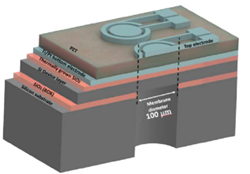
PMUTs generate ultrasound through vibration of a drum‑shaped thin‑film membrane consisting of a ~1 µm piezoelectric layer sandwiched between electrodes on a silicon membrane. Fabrication uses standard lithography and thin‑film processes, enabling mass production, miniaturization, high design complexity, and CMOS integration. Recent PMUT developments address previous technical limitations that restricted their use in medical ultrasound probes.
The platform also supports 2D PMUT arrays, enabling true real‑time 3D imaging within an ultrasound patch for the first time. Three‑dimensional images are acquired in fractions of a second using electronic beam steering, without any physical movement of the patch.